Could a Timeline Help Explain a Recurring Casino Account Problem?
Introduction
A casino account problem that disappears and then returns is hard to diagnose from memory alone. One failed login may seem like a password issue; a later blocked withdrawal may look like a separate payment problem. But the order of events can show whether these are isolated incidents or symptoms of the same unresolved issue.
Without details about a specific account, it would be irresponsible to assign a cause. There is no evidence to show whether the problem involves identity checks, security controls, payment processing, software or an account-holder error. A timeline cannot prove what happened, but it can help separate known facts from suspicions.
The actors: account holder, platform and payment chain
An account-related problem can arise at several points. The account holder provides login details and personal information; the casino platform manages access and account records; and payment providers may handle deposits and withdrawals. A problem the user encounters does not, by itself, reveal which part of this chain is responsible.
That distinction matters. If access fails after a password change, the timing may be relevant, but it does not prove the change caused the failure. If a withdrawal is delayed after documents are submitted, the events are linked in time, but the cause could still be a review procedure, an incomplete submission or another process the user cannot see.
A clear account of the issue keeps these actors separate. It records what the user did, what the platform displayed, what any payment provider reported and when each event occurred. This avoids a common mistake: treating one event as the cause of another simply because it came first.
Key factors: what belongs on the timeline
Start with dates and times, including the time zone if possible. Record observable events such as login attempts, password resets, account notices, document uploads, deposits, withdrawal requests and support messages. Exact wording can matter, so save notices rather than relying on memory or paraphrasing.
Distinguish actions from outcomes. Uploading a document is an action; confirmation that it was received is an outcome. Requesting a withdrawal is not the same as seeing it processed. Recording each step separately can show where the process appears to stop without assuming why.
Pay attention to recurring patterns. Does the problem follow a particular login, a change to account details, a payment attempt or a verification request? Does it affect only withdrawals or the account more broadly? A repeated problem after the same trigger may offer a useful lead, but other explanations still need to be considered.
Record successful events too. If the user logged in on a particular date, or a deposit went through while a withdrawal remained pending, that contrast helps define the problem. A timeline that includes only failures can make a disruption seem more constant or widespread than it was.
Finally, separate confirmed facts from inferences. A platform notice saying an account is under review is confirmed information. The belief that a particular transaction prompted the review is an inference unless a reliable record establishes the link.
The scenario: how a recurring problem might unfold
Consider a hypothetical sequence. A user cannot access an account on Monday, resets the password and logs in later that day. On Thursday, a withdrawal request remains unresolved, and the user receives a request for more information. The account seems to work again, but a similar access problem returns the following week.
Treated as separate complaints, these events might suggest three explanations: a faulty password, a payment delay and a new security check. On one timeline, they raise a more focused question: is there a documented trigger linking the access failures to the withdrawal review, or did unrelated events happen around the same time?
The answer depends on the records. If a notice says access was restricted pending verification, and it predates both failed logins, that supports a link between the restriction and the access problems. If no such notice exists, the timeline cannot establish that explanation. It can still show when the account holder first reported the issue and whether later communications changed the platform’s stated position.
Repeated symptoms do not necessarily have the same cause. A login failure may recur because of a saved password, a device issue or a platform restriction; a delayed transaction may have another explanation. A timeline narrows the possibilities, but it cannot replace a response from the relevant party or records the user cannot access.
Why the sequence can change the analysis
Chronology helps test cause and effect. If a problem began before a suspected trigger, that trigger cannot explain the first occurrence. If the problem follows the same change each time, that change is worth investigating, though timing alone does not prove a connection. This is more reliable than focusing on the latest incident or the explanation that seems most plausible.
A clear sequence can also reveal contradictions. A user may remember being told that documents were missing, while a confirmation shows they were received earlier. One message may describe a temporary restriction, while a later one refers to a different issue. Such discrepancies do not automatically indicate misconduct, but they point to questions that need specific answers.
A concise chronology is more useful in a review than a collection of screenshots without context. Each entry can include the date, event, source and whether the information is confirmed or inferred. This makes it easier to compare the account holder’s experience with platform notices and transaction records without making unsupported claims about intent or responsibility.
Conclusion
A timeline can help explain a recurring casino account problem by showing what happened, in what order and around which events the symptoms appeared. Its value is in making patterns and gaps visible, not in turning coincidence into proof.
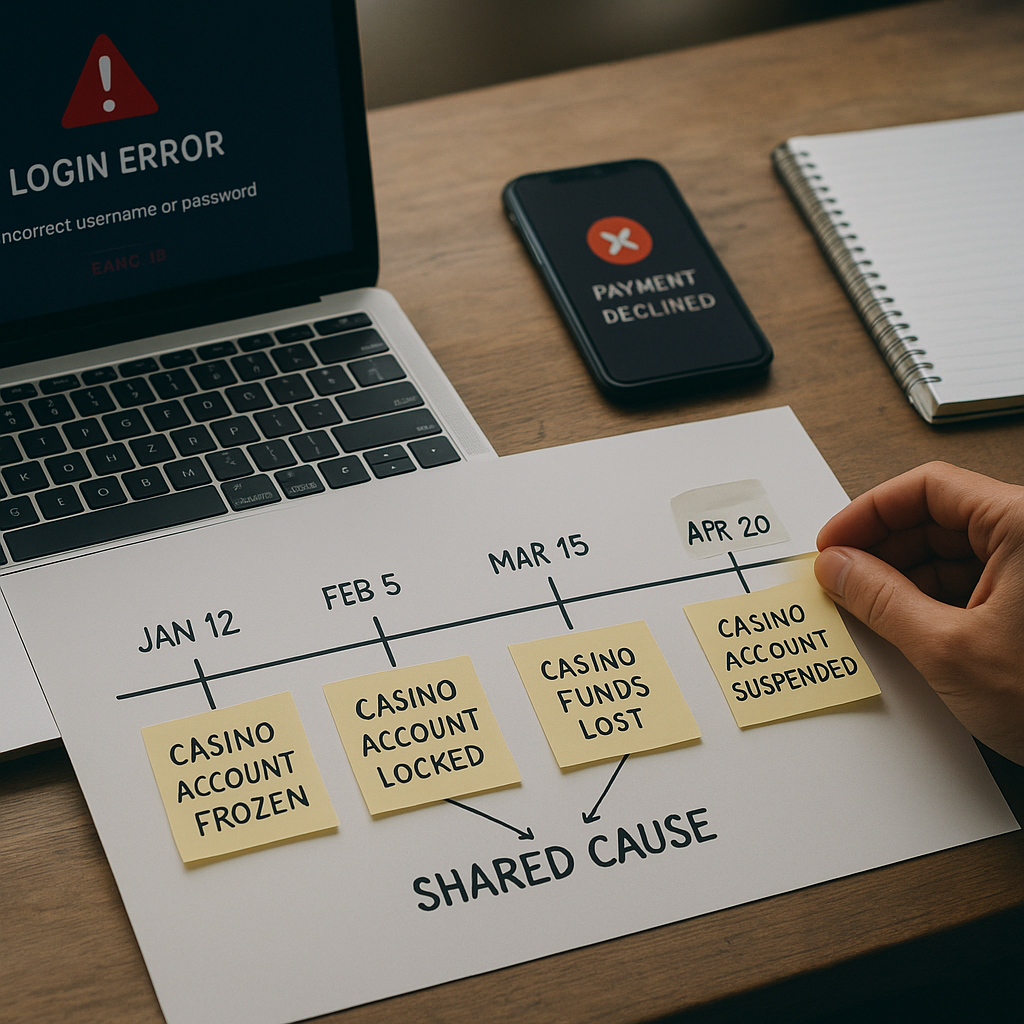
When the facts are limited, the conclusion should be limited too. A careful chronology can show whether several incidents may be connected, distinguish platform statements from user assumptions and clarify what remains unanswered. That provides a firmer basis for understanding a recurring problem than treating each episode separately.